Your Marketing Stack Is Growing
Modern marketing teams rarely operate with one platform. They may use:
CRM. CDP. Analytics. Advertising platforms. Marketing automation. CMS. E-commerce platforms. Social tools. Customer support systems. Data platforms.
Each solves a specific problem. But adding more tools doesn’t automatically create a better marketing operation.
The 2026 MarTech landscape continues to span hundreds of categories and thousands of solutions, including CRM, marketing automation, analytics, CDP, commerce, SEO and customer experience technologies.
The real value isn’t necessarily in the number of platforms. It is in how well they work together.
What Is Marketing Technology?
Marketing technology, commonly called MarTech, refers to the software, platforms, data infrastructure and technologies businesses use to plan, execute, personalise, measure and optimise marketing.
A modern MarTech stack can include:
- CRM systems
- Customer Data Platforms
- Marketing automation
- Marketing analytics
- Advertising technology
- Content management systems
- E-commerce platforms
- Personalisation tools
- Attribution systems
- AI tools
The objective isn’t to collect technology. The objective is to connect intelligence.
The Problem With a Disconnected MarTech Stack
Imagine a customer interacts with your business in five different ways. They:
Visit your website.
Download a report.
Click an advertisement.
Speak with sales.
Purchase a product.
If those interactions exist in disconnected systems, each team may see only part of the story. Marketing sees the campaign. Sales sees the lead. Commerce sees the transaction. Analytics sees the website behaviour. Customer service sees the support history. But the customer experienced only one journey.
That gap is where a connected MarTech stack becomes valuable.
Your Marketing Technology Should Work Like a System
Think of the ecosystem as:
Customer → Data → Intelligence → Action → Measurement → Learning
A customer interacts with the brand. Data captures the interaction. Systems interpret the information. Marketing responds. Performance is measured. The results feed back into the system. The cycle continues. The objective is not more technology. It is a better feedback loop.
7 Elements of a Connected Marketing Technology Strategy
1. Start With the Customer Journey
Don’t begin by asking:
“Which marketing technology should we buy?”
Start with:
“What does the customer journey look like?”
Map the journey:
Discover → Explore → Evaluate → Engage → Purchase → Return
Then identify what data and technology are required at each stage. This prevents technology from becoming the starting point. The customer journey should come first.
2. Connect CRM and Customer Data
Your CRM may tell you who the customer is. Your analytics may tell you what they did. Your commerce platform may tell you what they purchased. A customer data layer can help bring these signals together. The result is a more complete understanding of the customer.
Instead of:
Who is this person?
You can begin asking:
What is this customer trying to do?
What have they already experienced?
What should happen next?
That is where customer data becomes useful.
3. Move From Data Collection to Data Activation
Collecting data isn’t the same as using it. A business may have millions of customer records and still struggle to personalise experiences. The important step is activation.
For example:
Customer behaviour → Segment → Insight → Personalised Experience
A visitor repeatedly viewing one product category could receive relevant content. A returning customer could see a different experience from a first-time visitor. A high-intent lead could trigger a sales workflow. Data becomes valuable when it changes an action.
4. Make Marketing Automation More Intelligent
Traditional marketing automation often follows simple rules. If X happens → do Y.
That’s useful. But modern marketing automation can incorporate more context. For example:
Behaviour + Customer Data + Intent + History → Next Best Action
This can support:
- Lead qualification
- Audience segmentation
- Personalised campaigns
- Customer journeys
- Reporting
- Data enrichment
- Campaign optimisation
- Follow-up workflows
The objective isn’t to remove human judgment. It is to reduce repetitive work around human judgment.
5. Connect Marketing With Commerce
Marketing shouldn’t end when someone clicks an advertisement.
The journey continues.
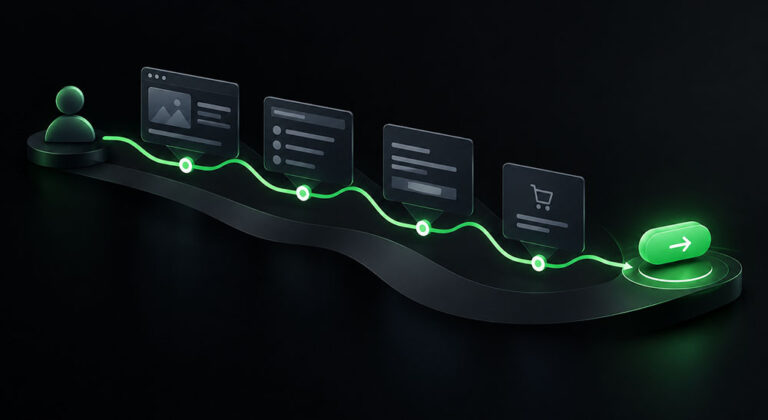
Ad → Landing Page → Product → Cart → Checkout → Purchase → Retention
If these systems aren’t connected, marketers may optimise campaigns without understanding the commercial outcome.
Connected commerce data changes the conversation.
Instead of asking:
“Which campaign generated clicks?”
you can ask:
“Which campaign generated valuable customers?”
That is a much more useful question.
6. Build Measurement Around Business Outcomes
Marketing dashboards can contain hundreds of metrics. Impressions. Clicks. Engagement. Traffic. Conversions. Leads. Revenue. The challenge is connecting them.
A useful measurement framework might look like:
Reach → Engagement → Intent → Conversion → Revenue → Retention
Each stage answers a different question. The goal isn’t to eliminate channel metrics. It’s to connect them to business outcomes.
7. Design the MarTech Stack Around Integration
A marketing technology stack shouldn’t become a collection of isolated tools. It should have a clear architecture.
For example:
CRM → Customer Data → Analytics & Intelligence → Marketing Automation → Experience & Commerce → Measurement
The exact platforms will differ by business. The principle remains: Technology should reduce fragmentation, not create more of it.
CRM vs CDP: What’s the Difference?
These technologies are often discussed together. A CRM primarily manages customer and prospect relationships, interactions and commercial information. A CDP, or Customer Data Platform, is designed to bring together customer data from multiple sources to create more unified customer profiles and support activation. They can work together.
For example:
CRM → Relationship
CDP → Customer Data
Analytics → Behaviour
Automation → Action
Commerce → Transaction
The right architecture depends on the business, data environment and customer journey. There is no universal “best” MarTech stack.
AI Is Changing the Role of Marketing Technology
AI is becoming increasingly embedded within marketing technology. It can support:
- Audience analysis
- Predictive insights
- Content generation
- Personalisation
- Campaign optimisation
- Data interpretation
- Workflow automation
- Customer interactions
But AI doesn’t fix disconnected systems by itself. If the underlying data is fragmented, AI may simply make decisions using fragmented information.
That is why: AI + Data + Integration
can be more valuable than AI alone.
More Marketing Tools Do Not Always Mean More Capability
There is a natural temptation to keep adding platforms. A new analytics tool. A new AI tool. A new automation platform. A new personalisation engine. But every additional platform can introduce:
- More data silos
- More integrations
- More maintenance
- More training
- More complexity
Before adding another tool, ask:
What business problem are we solving?
What data does it require?
Where does that data currently live?
What system should act on the insight?
How will we measure the result?
Technology should answer business questions. Not create more of them.
A Practical MarTech Audit
Ask these questions:
Customer Data
- Do we have a consistent view of the customer?
- Is customer data accessible across relevant teams?
- Are data definitions consistent?
Integration
- Do our key platforms exchange information?
- Are important processes still dependent on manual data transfer?
- Are there unnecessary data silos?
Automation
- Which repetitive workflows can be automated?
- Are automated journeys based on meaningful customer signals?
Personalisation
- Are we using behavioural data?
- Can experiences change based on customer context?
Measurement
- Can we connect campaigns to commercial outcomes?
- Can we identify the sources of qualified customers?
AI
- Where can AI improve decision-making?
- Is the underlying data reliable enough to support AI?
If the answers are unclear, the opportunity may not be another platform. It may be better integration.
The Value Is in the Connection
A CRM alone is useful. Analytics alone is useful. Automation alone is useful. Commerce technology alone is useful. But when they work together, something changes.
Data informs decisions. Decisions trigger actions. Actions create experiences. Experiences generate new data. And the cycle continues. That is the real opportunity of connected MarTech. Not more tools. More intelligence between them.
How nZeroOne Helps
At nZeroOne, we connect strategy, MarTech, data, digital experience, performance and technology to help businesses build connected marketing ecosystems. From CRM and customer data to analytics, automation, personalisation and digital experience, we help organisations turn fragmented marketing technology into connected business capability.
Explore nZeroOne →