Everyone Wants More Conversions
The conversation around website performance often starts with a familiar question:
“How do we increase conversions?”
The usual answers follow. Change the headline. Test the button. Add a popup. Shorten the form. Try a different CTA. Run an A/B test.
These tactics can be useful. But they focus on one moment.
The click.
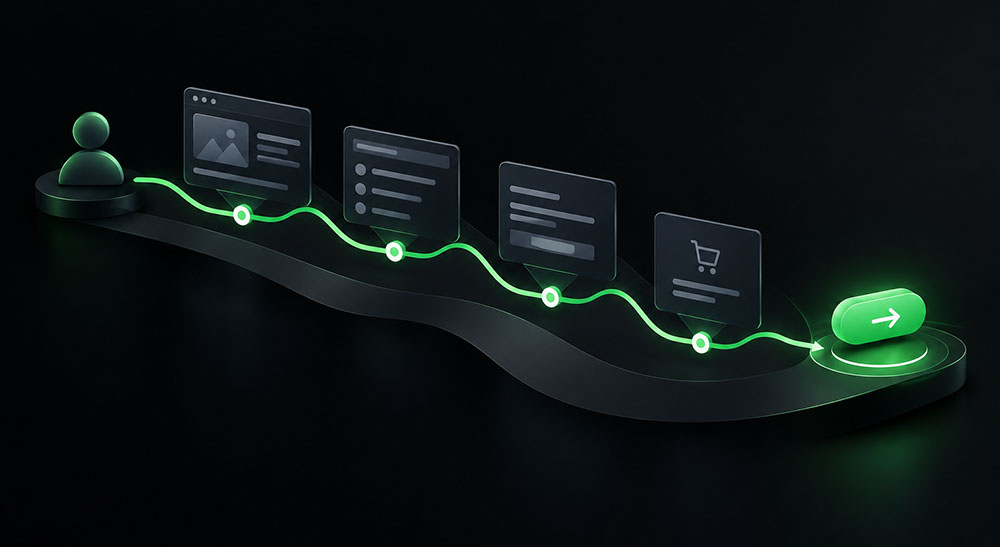
Customers experience something much larger.
They discover your brand. They explore your offering. They look for information. They compare alternatives. They evaluate trust. They consider risk.
Then they decide. That’s why conversion rate optimization needs to look beyond the CTA.
What Is Conversion Rate Optimization?
Conversion Rate Optimization, or CRO, is the process of improving a digital experience so that a greater percentage of users take a desired action.
That action could be:
- Submit an enquiry
- Request a consultation
- Book a demo
- Purchase a product
- Download a resource
- Start a conversation
- Subscribe
- Complete a form
CRO focuses on systematic improvement through areas such as user experience, testing and data-driven decision-making rather than simply increasing traffic. But conversion isn’t created by one element. It is influenced by the entire experience:
Message → Design → Navigation → Content → Trust → Interaction → Action
The Customer Doesn’t See Your Funnel
Internally, businesses often divide responsibilities.
Marketing owns acquisition. Design owns UX. Sales owns leads. Technology owns the website. Commerce owns transactions. Analytics owns measurement.
But customers don’t experience these departments separately. They experience:
One journey.
If the advertisement promises one thing and the landing page delivers another, the customer experiences a disconnect.
If the website creates interest but the form creates friction, the customer experiences a disconnect.
If the product page creates confidence but checkout feels uncertain, the customer experiences a disconnect. Conversion happens across the journey, not inside one button.
The Conversion Journey
A useful way to understand the customer journey is:
1. Discover The customer becomes aware of the brand.
2. Explore They begin looking for information.
3. Understand They try to determine whether the offering fits their needs.
4. Trust They look for evidence.
5. Decide They compare alternatives and evaluate risk.
6. Act They submit, purchase, book or enquire.
Each stage creates different questions. And each question creates a different opportunity for conversion optimization.
8 Areas to Examine Before Changing Your CTA
1. Clarity
Can the visitor understand what you offer quickly? A strong page should answer:
What is this?
Who is it for?
Why does it matter?
What should I do next?
If those answers are unclear, changing the CTA won’t solve the underlying issue. Clarity comes before conversion.
2. Relevance
A visitor arriving from a campaign has a specific expectation. If an advertisement says:
“B2B Website Design”
but the visitor lands on a generic corporate homepage, the journey loses continuity.
The landing experience should align across:
Message → Offer → Design → Expectation
The closer the experience matches the original intent, the less work the customer has to do.
3. Information
Customers don’t convert simply because a business asks them to. They convert when they have enough information to make a decision. Depending on the offering, they may need:
- Features
- Benefits
- Pricing information
- Use cases
- Comparisons
- FAQs
- Case studies
- Technical information
- Implementation details
The amount of information required depends on the complexity and risk of the decision. The experience should answer the questions that stand between interest and action.
4. Trust
Every conversion involves some level of uncertainty. Especially for high-value products and services. Customers may wonder:
Can this company deliver?
Have they done this before?
Will this work for my business?
What happens after I enquire?
Trust signals help reduce that uncertainty. These may include:
- Client stories
- Case studies
- Testimonials
- Certifications
- Industry experience
- Results
- Demonstrations
- Expert content
The objective isn’t to make the company look impressive. It’s to make the decision feel more informed.
5. Friction
Friction is anything that makes the desired action unnecessarily difficult. For example:
- Long forms
- Confusing navigation
- Slow pages
- Unclear pricing
- Repeated information
- Difficult checkout
- Poor mobile experience
- Unexpected steps
Not every step is bad. Some information may genuinely be necessary. The goal is to remove unnecessary friction.
6. Navigation
Your internal organizational structure isn’t necessarily your customer’s journey. A company might organize its website around:
Marketing. Technology. Consulting. Design.
But the customer may be thinking:
“I need more qualified leads.”
“Our website needs to convert better.”
“We need to launch e-commerce.”
“Our brand needs repositioning.”
Good navigation starts with user intent, not internal departments.
7. Performance
A beautiful website still has to work. Check:
- Page speed
- Mobile performance
- Image optimization
- Script efficiency
- Interaction speed
- Form performance
- Checkout performance
Performance isn’t merely a technical metric. It affects the experience customers have with the brand. Every second of unnecessary friction is part of the journey.
8. Measurement
You cannot optimize what you cannot understand. Look beyond the final conversion. Measure:
Where did the visitor come from?
What did they view?
Where did they hesitate?
Where did they leave?
What did they interact with?
Which CTA did they use?
Which channel generated the qualified lead? Analytics turns assumptions into evidence.
The Conversion Rate Optimization Formula
A useful way to think about digital conversion is:
Traffic × Experience × Trust × Clarity × Action = Conversion
Traffic brings people in. Experience determines how they move. Trust reduces uncertainty. Clarity makes the decision easier. Action gives them a next step. If one element is weak, the overall experience can suffer. You can have:
Excellent traffic + poor experience
or
Beautiful design + weak trust
or
Strong content + unclear action
The website needs to work as a system.
CRO Is Not About Manipulating People
Conversion optimization is sometimes associated with aggressive tactics. Popups everywhere. Artificial urgency. Dark patterns. Repeated prompts. That isn’t the only way to improve conversion.
Good CRO is often much simpler. Make information easier to find. Make value easier to understand. Make trust visible. Make navigation intuitive. Make forms simpler. Make the experience faster.
The best conversion experience can feel almost invisible. The customer simply gets what they need.
How SEO and CRO Work Together
SEO can bring qualified visitors to a website. CRO focuses on what happens after they arrive.
That creates a relationship:
Search Intent → Relevant Content → Digital Experience → Trust → Conversion
A page that ranks for a keyword but fails to answer the visitor’s intent may attract traffic without creating meaningful business outcomes.
A page designed around both search intent and customer needs can do more. It can:
- Answer the query
- Build relevance
- Establish expertise
- Reduce uncertainty
- Create a logical next step
This is why SEO and conversion rate optimization should not operate as completely separate activities.
Traffic creates opportunity. Experience determines what happens next.
A Practical Conversion Optimization Audit
First Impression
- Can someone understand the business quickly?
- Is the value proposition clear?
- Does the page communicate relevance immediately?
Journey
- Is the next step obvious?
- Does each page lead logically to the next?
- Does the experience reflect customer intent?
Content
- Does the content answer real customer questions?
- Is it focused on outcomes?
- Is enough information available to make a decision?
Trust
- Are case studies visible?
- Are relevant results demonstrated?
- Are credibility signals easy to find?
Conversion
- Is there a meaningful CTA?
- Does the CTA match the user’s intent?
- Are forms unnecessarily long?
Performance
- Is the website fast?
- Does it work well on mobile?
- Are interactions smooth?
Measurement
- Are important actions tracked?
- Can you identify where users drop off?
- Can you connect conversions to acquisition channels?
If several answers are “no,” the opportunity may not be more traffic. It may be a better journey.
Your Website Is Part of Your Sales Team
Your website works before your sales team enters the conversation.
It explains your offering.
It answers questions.
It demonstrates expertise.
It builds confidence.
It addresses objections.
It creates the next step.
That’s why website optimization shouldn’t be treated as a cosmetic redesign. A better website isn’t simply prettier. It’s easier to understand.
Easier to trust.
Easier to navigate.
Easier to act on.
The Future of CRO Is Journey Optimization
The next generation of conversion rate optimization won’t be defined only by better buttons.
It will be about understanding the complete customer journey.
Where did the customer come from?
What did they expect?
What did they need to know?
What created confidence?
What created friction?
What finally moved them to action?
That requires the combination of:
UX + Content + Data + Analytics + Technology + Strategy
CRO is becoming less about optimizing pages in isolation. It’s about optimizing the experience as a system.
How nZeroOne Approaches Digital Experience
At nZeroOne, we combine strategy, UX/UI, web development, content, SEO, performance marketing, analytics and technology to create digital experiences designed around real business outcomes. From website strategy and journey mapping to conversion optimization, digital experience and performance, we help businesses turn digital interactions into measurable opportunities.